Friday, February 29, 2008

Electricwest: <i>Divine de Vice</i> (Archaic Horizons mp3/digital)


I wrote about Electricwest's limited edition CD, Together We Fade, about a month ago, and he has already followed it up with this release on the netlabel Archaic Horizons, a full-length release that pairs each of its seven new tracks with at least one remix.

This release continues Electricwest's languid journey through a hazy, melancholy landscape of instrumental electronic music. Many of his originals persist at the intersection of light ambience, slow, downtempo grooves and detail-oriented, fussy programming, all tying into his over-arching vision for something sedate, beautiful and occasionally tragic. The best original example of this here is "Before You Know I'm Gone," whose title alone suggests a certain amount of regret and/or reticence. The music reflects this achingly, with a repetitive musical phrase anchored by skittering percussion and a slow and steady drum track. It's complemented well by Milieu's reworking, which introduces a more pronounced melodic layer and a more crisp, streamlined drum track. It's probably the most typical "IDM" piece to be found herein, but it's gorgeous, both clean and clear as well as a bit "off" in some of the detuned chords that support the melody. "Because of You" is comparable to "Before You Know..." in its patient tempo and crisp break, with a warbly synth roaming overhead, but I actually prefer the remix by Celer, which removes the rhythm track altogether and consists primarily of decaying, slow synth pads. This dichotomy occurs yet again with "Hello Stranger," a nice downtempo track characterized by skittering details and a delicate melodic phrase, whose remix strips away the beats and is highly textural with the use of manipulated vocal samples and drones.

My personal favorites are the original and remix of "Where'd You Go?" Completely beatless, the original starts off with a faint drone, building into a fog that suggests momentum but never really lifts off. But the David Tagg remix is really something; his "Mall Security Mix" amps up the tension while increasing the haze, making it feel like an overpowered field recording of incidental sound, much like that constant lull that accompanies a far-off lawn mower or a heavy-duty vacuum that's 3 floors up.

As an album it's an interesting split, starting off with the originals which are quite nice, and then moving through the remixes which begin more typically as reworkings with new drum tracks, added melodies, etc, but then begin to mutate into something far more surreal and other. In this way, the album flows very well despite not being all original material, and it's an impressive exercise in track ordering since disjointedness can often be the downfall of a remix collection (let alone when remixes are adjacent to originals).

It's another handsome entry in the repertoire of Electricwest, and I for one am delighted that he's made this available for free.

download it here
more information: Myspace | Archaic Horizon

Wednesday, February 27, 2008

Signal: <i>Robotron</i> (Raster-Noton CD)


I grabbed Signal's album on an impulse, having heard a few clips but not knowing much about it. Listening to the album, it is through and through pure Raster-Noton. All the calling cards are there: crisp, digital signals, rhythmic clicks and blips, an attention to white space, and more or less a complete lack of melody. The most immediate association, however, when listening to the various eleven tracks of Robotron, was the Finnish duo Pan Sonic. Many of the more rhythmic qualities of Robotron hark back toward Pan Sonic's earlier days as a post-techno outfit (circa Vakio or Kulma), although these tracks are more removed from the dancefloor than some of those old Panasonic records.

It's funny what certain name associations bring to the table, though; when I learned the identity behind Signal, I was far more prone to excuse the somewhat sound-alike quality of these tracks. Signal is a sort of Raster-Noton supergroup, including Carsten Nicolai (Noto), Olaf Bender (Byetone) and Frank Bretschneider (Komet) in a series of studio improvisations or live recordings made over the course of five or so years. The closest comparison to any of those artists' solo work would be Bretschneider's, especially his newfound appreciation of more aggressive rhythm. It is the beat that drives these tracks, unifying the entire release into what feels like movements of a singular idea. The first set of tracks sounds fairly separate from the second set, though, displaying a heftier version of what each of these artists is good at on his own; "Naplafa" has an urgency in its repetition and line-noise rhythm section, which segues into the title track in all its bit-crushed glory. The bass kicks into high gear on "Malimo" with a thudding regularity that makes it feel more aggressive, but the second half of the album both expands upon and diverts from this aggression in equal amounts.

Starting with the grinding "Rawema," the trio begins to expand on the core ideas explored in the previous half of the album. There are more suggestions of bassline and melody, even in the relentless distorted growl of "Rawema," but especially in the clipped strides of "Sporett" which has an actual bassline, tiny drum sounds and what appears to be a vocoded voice that loops along with the rhythm. "Epirex Motor" continues this rhythmic exploration, with a clarity in the individual sounds that shakes off much of the more relentless quality of the earlier tracks, instead relying on a disorienting flurry of tweaked, flanged high-end noises. Closer "Wismut" brings things full circle, re-incorporating some of the darker edge of the earlier tracks alongside some of the more succinct and brighter noises found across the board.

Robotron effectively showcases each producer's ability to manipulate digital sound, both in terms of timbre but also with a keen ear for rhythm and progress. Because of this, it tucks neatly alongside these artists' individual repertoires as well as the Raster-Noton catalogue. Not necessarily surprising, but quite a ride.

Signal live at Volksbühne, Berlin, October 2007


mp3: Rawema | Sporett
more information: Raster-Noton
buy it: Bent Crayon | Forced Exposure | Boomkat | Emusic | iTunes

Tuesday, February 26, 2008

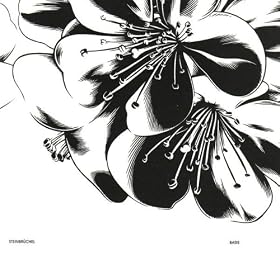
Steinbr&#252;chel: <i>Basis</i> (Room40 CD)


Steinbrüchel is the ambient/abstraction project of Swiss producer Ralph Steinbrüchel, who has a tendency to create extended meditations based on previously recorded material or field recordings. Basis is no exception, consisting of highly processed reworkings of recordings of guitar music from Ben Frost and Lawrence English, as well as one very long take around the piano music of Bernd Schurer.

This album is nothing if not consistent -- if, based on listening to the clip I've posted, you are bored, or you don't like it, this is surely not the album for you. Steinbrüchel is not interested in drama or dynamics, but seems perfectly content painting an aural canvas that is subtly textured and somewhat monochromatic. If one were to compare his music with a painter's work, it might be Ad Reinhardt. Abstraction here is taken to a reasonable extremity, removing most traces of the guitar as a proper instrument and turning it into a series of drones, surfaces and overtones.

Each of the Lawrence English abstractions are numbered "Interlude 1" through "Interlude 4," and they are the most serene of the lot. They bookend and alternate within and around the other pieces, with most discernable tones sounding more like sedated chimes or synths than guitar, and most often sounding like an ebbing tide of drones. Each of the "Interludes" is shorter (averaging 5 to 7 minutes). By contrast, the Frost and Schurer pieces are far longer; the patience found in these extended interpretations by default lends to them more subtlety, traveling quite slowly from point A to B, and occasionally to point C or D from there. For instance, "These 1"'s introductory haze bristles for several moments before subsiding and gradually evolving into what sounds like a muted, somber rendering of Frost's "Theory of Machines" track (taken from his album of the same name, released last year). It shows how far very little can go, because it's not all that different from Frost's recording, consisting of the same repetitive chords, but completely declawed and neutralized into something less sinister and more meditative. Likewise, "These 2" (the other Ben Frost interpretation) begins as a dense fog of sound but gradually becomes distilled into something of a muted sparkle. Even more glacial is "Falter," a 20-minute take on the piano recordings of Bernd Schurer, which mutates slowly, gradually shifting in tone and color until it finally dissipates with a quiet sputter in its final moments.

This is not music that especially tells a story, or has any real entertainment value. It's a quiet series of studies in patience and restraint, which, when given the proper listening environment and attention, are quite rewarding.

mp3: These 1
more info: Room40 | Post Everything
buy it: Boomkat | Amazon | Emusic | iTunes

Monday, February 25, 2008

Aril Brikha: <i>Ex Machina</i> (Peacefrog CD)


It's not uncommon for fans of techno or house to turn their noses up when they even hear the word "trance" as applied to club music. It conjures up associations with obnoxious arpeggios, epic breakdowns and shamelessly out of the box sawtooth synth leads which, in the wrong hands, can sound tedious at best. Still, "trance" was not always a dirty word; one need only look back to the earlier days of Sven Väth et al to see that what was once called trance is now usually just referred to within the techno catch-all.

Aril Brikha's newest album for Peacefrog succeeds in the face of the trance tag, and perhaps because of it; these songs have some things in common with the subgenre without being tedious or derivative, and without being defined by any specific subset of the electronic dance arena. Perhaps it's the large scale of some of the best tracks here, shifting from something inspiring to complete anthems. "Lady 707" has a repetitive melodic pattern that works well over its midrange drum kit, an unusual combination that reflects Brikha's affinity to the dance music of the past along with current trends. The same is true for "Leaving Me" which is truly epic in its 11-minute play time and big melodic swells, again reflecting elements of trance without the cheese factor. "Room 337" has the same tendency toward melancholy melodic patterns, but is a bit more urgent and a bit less dramatic. It helps provide a sense of movement through the album, starting with a couple songs that point toward vintage Detroit, then toward the more melodic trance sound and then something different... "Contact" is a chunky groove with a thick bassline and cool melodic phrase while I'm assuming "Kind of Nitzer" is a nod to the UK EBM duo, with a dark buzzy bassline and needling high-end pattern. What's refreshing here is that regardless of what direction Brikha is pointing toward, the past, present or future, nearly every track is slickly assembled and shares his knack for strong chord progressions and synth pads that have a high gloss about them. This love of melodic drama unifies all of Ex Machina's disparate tracks, nearly all of which work just as well on a dancefloor as off. There are no throwaway tracks here, and so Brikha successfully dodges the bullet that is so often the downfall of the techno full-length.

mp3s: Lady 707 | Leaving Me
more information: Peacefrog | Myspace
buy it: Boomkat | Amazon | iTunes | Emusic

Sunday, February 24, 2008

TTC: <i>3615 TTC</i> (Big Dada/V2 France CD)


French rap outfit TTC are somewhat of an anomaly in my musical taste, and even writing about them is, for me, a dicey prospect to a certain extent. Generally I'm not much of a hip hop fan, and when I hear the genre done in a foreign language it usually makes me either chuckle or roll my eyes. (DJ Krush's albums with Japanese rap in the late 90s just made me cringe, despite how much I think Krush is a good producer.) So why do I like this TTC album?

Whatever you might make of their vocal styles, they're nothing if not distinct, and under those punchy rapid-fire vocals are some really weird rap and R&B productions. They're not so weird as to be divorced from the genre altogether, but TTC themselves have expressed an interest in creating rap music for people who don't really like rap music. Despite that proclamation, TTC remains obviously indebted to various American production techniques ranging from the Dirty South to Anticon, even as they continually dodge direct comparisons. Production crew FuckALoop, originally tangential but now a more integral part of the project with this record, also throw in a great deal of other stuff, drawing from the dance music of the 80s and 90s in equal parts (with a healthy dose of vintage rave), as well as more straight-up R&B for a couple tracks which incorporate actual singing courtesy of backing vocalists.

And, then again, there are those voices. Alternately cartoonish and seductive, it's hard to take them too seriously, but I suspect TTC wouldn't have it any other way. Each of the three MCs has his own style, with Teki Latex having a shouty, more obnoxious quality, Tido Berman lending a smooth, almost melodic vibe and Cuizinier contributing a weirdly sexy deep voice that falls somewhere between a groan and a tease. Despite having a basic knowledge of French, I can't keep up with them to understand what they're saying; I have to read lyrics on paper and loosely translate (although at times, the meaning is pretty obvious). That said, I can't be a very good judge of this music for lyrical content, and I've read comments online that their lyrics are not so hot, but to me they don't appear to be written without a sense of humor. But for every steamy track like "Strip Pour Moi," there is the occasional embarrassment like "Frotte Ton Cul Par Terre" (set to the tune of "Hokey Pokey," loosely translated the title means "Drag your ass on the ground"). But then they treat us to the almost sublime "J'ai le son" with its decaying grime snares, or the sleek "Ambition," which is equal parts hip hop and "Chariots of Fire" (yes, it's pretty awesome). "Turbo" is another highlight, brimming with a buzzing rave synth and plodding, shouted vocals, while "Travailler" is a slinky R&B tune that is better heard in its jacked-up remix found on its single release. The album ends with a scorcher courtesy of buds Modeselektor who return the favor of TTC's guest spots on their records by providing the rousing "Une Bande de Mec Sympa," a fantastic rave anthem with a chorus shout. What TTC seem less prone to do is cutting apart and fragmenting their vocals, which Modeselektor do with reckless abandon on their own tracks; here there is a middle ground where Tido's voice is treated on the refrain as a staccato sample and there are several weird details where vocals are tweaked, stuttered, flipped or otherwise distorted around the primary lyrics.

It's an album that doesn't require that you understand the language to appreciate the music, or even some of their humor which comes through in style alone. And despite any of their leftfield tendencies, TTC are just fun and accessible enough to potentially cross over to broader audiences.

mp3s: Une Bande de Mec Sympa | Ambition
more information: Big Dada | Myspace | V2 France
buy it: Boomkat | Amazon | Emusic

Saturday, February 23, 2008

Valgeir Sigur&#240;sson: <i> Ekv&#237;libr&#237;um</i> (Bedroom Community CD)


Valgeir Sigurðsson has been an active figure in music production for some time now, having contributed and played with Sigur Rós, Björk, CocoRosie and others. In addition to these collaborations, he's managed to start his own imprint, Bedroom Community, which hosts a handful of promising artists. The first two records he released were from neoclassical prodigy Nico Muhly (another Björk collaborator) and Ben Frost, both of whose albums are considerably different from one another. Muhly's album is somewhat avant garde and almost exclusively for traditional instruments, whereas Frost's was an epic, dark ambient manipulation of Swans samples and electronics.

Even more of a departure is the label boss's own solo debut. Ekvílibríum is far from the more severe angle of either of the previous releases on the label, and rather is a lush, fully-formed pop album. Valgeir Sigurðsson's sharp techniques as a producer shine through in blazing colors here, with a spectrum of sound that is as deep and sensuous as it is bright and radiant. The first song, "A Symmetry," begins with what sounds like more common IDM rhythms but soon evolves into something altogether different with the use of bright melodic piano. (I'm not sure how or whether he's treated the piano sounds on the record, but it tends to sound unusually bright.) The logical companion to this opener is "Focal Point" which features some gorgeous piano melodic work from Nico Muhly along with some gentle and elegant viola courtesy of Una Sveinbjarnardóttir. It's probably my favorite track on the album, encapsulating all of the various aspects of the other songs (minus vocals) in one stunning 6-minute piece. The other instrumental pieces are nice as well, but at times more subtle; "Equilibrium Is Restored" is almost pastoral in its patient, dreamy pacing, and closing track "Lungs, for Merrilee" is a five-minute, vibrating meditation for piano and strings.

There are several vocal tracks on the album, including 2 contributions from Will Oldham (credited to his Bonnie "Prince" Billy alias), and one each from J. Walker and Dawn McCarthy. "Evolution of Waters" aims big in its sweeping arrangement for celeste, piano, strings and electronics, complementing Oldham's voice well. "Kin" falls toward the end of the album and also features Oldham's airy vocals over a comparable arrangement, very lovely stuff. J. Walker's collaboration on "Baby Architect" is a little more sleepy, built around guitar and oddly manipulated layers of flute, bassoon, strings and electronics, often falling back on a stuttering texture of Walker's voice, slowing down and speeding up through tape manipulations. "Winter Sleep" is the most dramatic of the vocal tracks, characterized by Dawn McCarthy's gorgeous voice, which ranges from a creamy alto to a bright operatic soprano. Her non-verbal vocals at times recall the soaring voice from Preisner and Kieslowski's The Double Life of Veronique, giving it an otherworldly quality at times.

It's a varied collection of songs and pieces that work well within and without one another; it flows quite well as an album, but these songs don't necessarily require one another to be appreciated. That there are just as many instrumentals as there are vocal tracks makes it all that much stronger, balancing between a sophisticated pop album and something more subtle or nuanced. It's a very well-produced, clean, smart collection of tracks that, especially when compared to the Bedroom Community repertoire thus far, indicates a world of possibilities for Sigurðsson's vision.

mp3: Focal Point | Winter Sleep
more information: Myspace | Bedroom Community
buy it: Directly from Bedroom Community's webshop | Amazon | iTunes | Bent Crayon | Forced Exposure | Tonevendor | Boomkat